
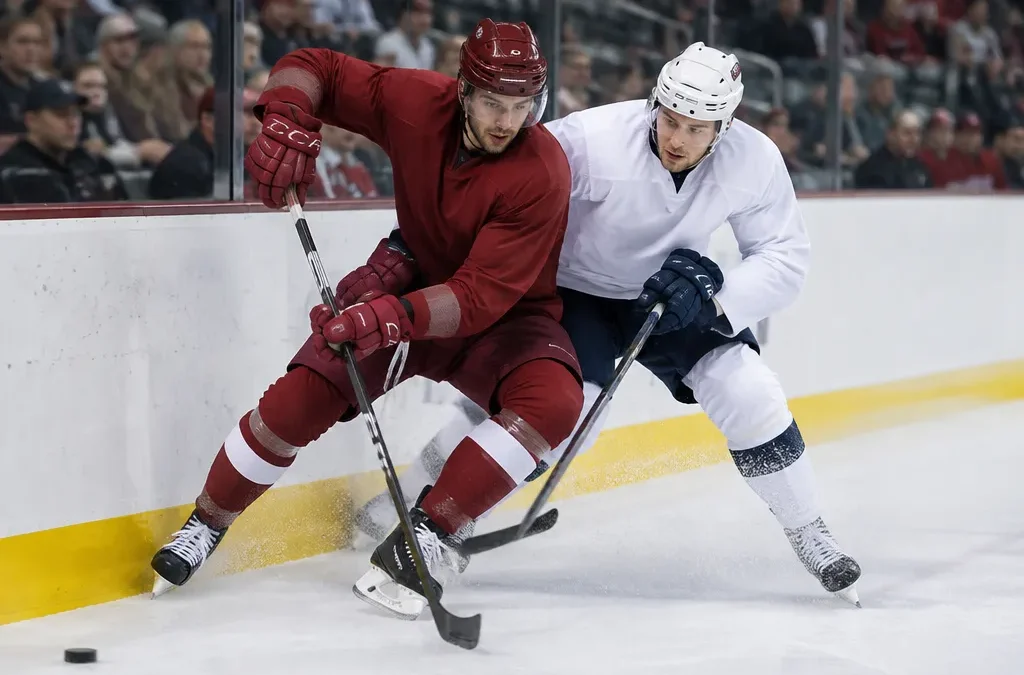
The AHL (American Hockey League) is the top minor league in North American hockey, one step below the NHL. The ECHL, formerly known as the East Coast Hockey League, sits one level lower, the “AA” tier, and serves as the second rung of the development ladder. Every one of the 32 NHL teams has its own AHL affiliate, while ECHL teams are mostly tied to an NHL club and its AHL partner. AHL players are faster, more experienced and far better paid, with a league minimum above $50,000 a season. ECHL players are paid by the week under a team salary cap, and most make well under that.
Put simply, the AHL is where NHL teams develop their best prospects and park depth players who could be called up any day. The ECHL is where younger or lower-ranked prospects get playing time, where veterans extend their careers, and where plenty of players chase a shot at the AHL.
ECHL vs AHL at a glance
| AHL | ECHL | |
|---|---|---|
| Level | Top minor league (“AAA”), one step below the NHL | Second tier (“AA”), two steps below the NHL |
| Teams (2026-27) | 32, one affiliate for each NHL team | 30, in 24 states and one Canadian province |
| Regular season | 72 games, Oct. 2, 2026 to April 11, 2027 | 72 games, Oct. 16, 2026 to April 11, 2027 |
| Championship | Calder Cup | Kelly Cup |
| Pay structure | Season salary with a league minimum | Weekly salary under a team salary cap |
| Minimum pay | $52,725 under the old CBA (2024-25); raised in the new deal | $610 a week for rookies, $660 for returning players (2026-27) |
| Team salary cap | None for AHL salaries | $18,000 a week (2026-27) |
| Veteran limits | Limit on veterans with 260+ pro games per lineup | Four veterans per roster (260+ pro games) |
| Labor deal | Through Aug. 31, 2030 | Through the 2029-30 season |
A short history of both leagues
The AHL traces its roots to 1936, and the 2026-27 season is its 91st. It has been the NHL’s primary development league for decades, and since the league’s expansion to 32 teams, every NHL club has its own AHL farm team, from the Rochester Americans for the Buffalo Sabres to the Bakersfield Condors for the Edmonton Oilers.
The ECHL started in 1988 as the East Coast Hockey League with five teams. It spread west over the years, absorbed teams from other minor leagues, and dropped the long name in 2003 because it was no longer an East Coast league. Today its teams stretch from Maine to Idaho, including clubs such as the Tulsa Oilers, the Rapid City Rush and the Idaho Steelheads.
Level of play: how big is the gap?
The gap between the AHL and the ECHL is real, and it shows up in pace and decision-making more than in raw skill. AHL rosters are full of first- and second-round draft picks, players on NHL contracts, and veterans with NHL games on their resume. The AHL says about 90 percent of NHL players spent time in the league on the way up.
ECHL rosters are younger and more mixed. You will see players on AHL contracts sent down for more ice time, recent college and junior graduates on their first pro deals, and veterans who have settled into long ECHL careers. The best ECHL players are close to AHL level, and teams move players between the two leagues all season.
For fans, both leagues offer fast, physical hockey at a fraction of NHL ticket prices. The AHL is a little cleaner and quicker. The ECHL tends to be looser, with more chaos in the neutral zone and a bit more of the old-school minor league feel.
How much do ECHL players make?
ECHL pay is built around a weekly team salary cap, which limits what a club can spend on its whole active roster. For the 2026-27 season, the ECHL sets the cap at $18,000 a week, with a slightly higher $18,610 for the first 30 days of the season. Teams must also spend at least $13,680 a week, the salary floor. Those figures come from the league’s official FAQ.
The league minimum for 2026-27 is $610 a week for a rookie and $660 a week for a returning player. A rookie in ECHL terms is anyone with fewer than 25 regular-season games at the AA level or higher.
With an active roster of up to 20 players (21 early in the season) sharing that $18,000, the average works out to about $900 a week. Stars and veterans take a bigger slice, so many players make closer to the minimum. ECHL salaries are paid only during the season, which runs about six months.
Players also get benefits that make the numbers go further. Teams typically cover housing, and players receive a per diem on the road. The new labor deal also added guaranteed season contracts and uninterrupted offseason medical coverage.
The 2025 ECHL strike and new CBA
ECHL players went on strike on Dec. 26, 2025, after the old collective bargaining agreement expired. The strike lasted four days and postponed 41 games. The league and the Professional Hockey Players’ Association ratified a new deal on Dec. 30, 2025, running through the 2029-30 season.
The agreement raised the salary cap by 19.8 percent immediately, paid retroactively to the start of the 2025-26 season, with more increases in later years. Before the deal, the cap had been $14,600 a week and the rookie minimum $530. The contract also added mandatory days off, a holiday break from Dec. 24 to 26 and limits on travel between back-to-back games.
How much do AHL players make?
AHL salaries are much higher and paid as a season salary rather than a weekly wage. Under the previous AHL collective bargaining agreement, the minimum salary in 2024-25 was $52,725. The AHL and the PHPA ratified a new five-year deal in January 2026, running through Aug. 31, 2030. It raised minimum salaries, per diem and the playoff pool, but the league has not published the new minimum.
Many AHL players earn far more than the minimum because they are on NHL contracts. A player on an NHL two-way deal has a separate minor league salary that he earns while in the AHL. Veterans on those deals can make six figures in the minors. For players on entry-level NHL contracts drafted in 2026 or 2027, the minor league salary is capped at $87,500.
The new AHL deal also introduced an AHL-only one-year entry-level contract and a buyout system, and it loosened the veteran rule slightly.

NHL affiliations and the development path
The typical path for a drafted prospect runs from junior hockey, college or Europe to the AHL, then to the NHL. The ECHL comes into play when a team has too many players for its AHL roster or wants a young player, often a goalie, to get regular starts instead of sitting on the bench.
Every NHL team has one AHL affiliate. The 2026-27 AHL season includes the Hamilton Hammers, the new affiliate of the New York Islanders. Most ECHL teams also have an NHL and AHL partner, and some NHL organizations share an ECHL affiliate. The ECHL is not a straight feeder league, though. Many ECHL players sign directly with ECHL clubs, and those teams are free to sign players with no NHL ties at all.
Movement goes both ways. An NHL team can recall a player from the AHL at almost any time, subject to waiver rules. An AHL team can send players on AHL contracts down to its ECHL partner, and can call up ECHL players on loan when injuries hit.
Types of contracts: two-way, AHL and ECHL
Three kinds of deals decide where a player can end up and what he gets paid.
- NHL two-way contract. The player signs with an NHL club. He earns his NHL salary when he is in the NHL and a lower minor league salary when he is assigned to the AHL or ECHL. The NHL minimum rises to $850,000 in 2026-27, so a call-up means a big raise.
- AHL contract. The player signs with an AHL team, not the NHL parent. He can play in the AHL or be assigned to the ECHL, but he cannot play in the NHL without first signing an NHL contract.
- ECHL contract. The player signs with an ECHL team and is paid a weekly salary under that team’s cap. He can be loaned up to the AHL when an affiliate needs a body.
Some players also sign professional tryout agreements, short trials that let a team take a look without a full contract.
Can ECHL players make it to the NHL?
Yes, and it happens every season. More than 700 players have reached the NHL after playing in the ECHL. Goalies are the classic example, because NHL teams want young netminders playing every night rather than sitting behind an AHL starter. Jonathan Quick, who later won two Stanley Cups with the Los Angeles Kings, spent part of his first pro season with the ECHL’s Reading Royals. Skaters make the jump too, usually by earning a call-up to the AHL first and then an NHL contract.
The route is harder than from the AHL, but it exists, and that is a big part of why ECHL players accept modest pay.
ECHL teams in 2026-27
The ECHL has 30 teams for the 2026-27 season, spread across 24 states and one Canadian province. The league runs mostly in the East, South and Midwest, with a handful of teams in the Mountain West and Southwest.
This season brings two new arrivals. The expansion New Mexico Goatheads start play in Rio Rancho, bringing pro hockey back to the area for the first time since 2008-09. The Trenton Ironhawks bring the ECHL back to Trenton, New Jersey, for the first time since 2012-13. The Iowa Heartlanders were approved for a voluntary suspension of operations in March 2026. The Augusta Lynx are slated to return for 2027-28.
The Florida Everblades are the defending champions. They beat the Kansas City Mavericks in six games in June 2026 to win their fifth Kelly Cup.
Below the ECHL: SPHL and FPHL
The ECHL is the lowest level with formal NHL and AHL affiliations, but it is not the bottom of pro hockey. Two more leagues sit below it.
- SPHL. The Southern Professional Hockey League is the “A” level, with teams mostly in the Southeast. Pay is lower than in the ECHL, and players often use the league to earn an ECHL call-up.
- FPHL. The Federal Prospects Hockey League is another step down and has grown fast, with plans for 17 teams in 2026-27. It is often a first pro stop for players out of junior or small college programs.
For the full history of these leagues and the many that came before them, see our guide to minor league hockey leagues past and present.
AHL or ECHL: which is better for fans?
If you want to see future NHL players, the AHL is the better bet. Many of the players you watch in an AHL game will be in the NHL within a year or two. If you care more about atmosphere, cheap tickets and a local team that feels like part of the town, the ECHL delivers that in dozens of mid-sized cities without an AHL club. Both leagues rely heavily on ticket sales, sponsors and promotions, which we cover in our look at minor league sports business.
Curious how hockey pay compares with other minor leagues? See what players make in minor league baseball and in the NBA G League.
Summary
The AHL is the top development league, one level below the NHL, with 32 teams tied one-to-one to NHL clubs and a season minimum salary above $50,000. The ECHL is one step lower, with 30 teams, a weekly salary cap of $18,000 and minimums of $610 to $660 a week in 2026-27. Players move between the two all season, and below them the SPHL and FPHL round out pro hockey in North America.