
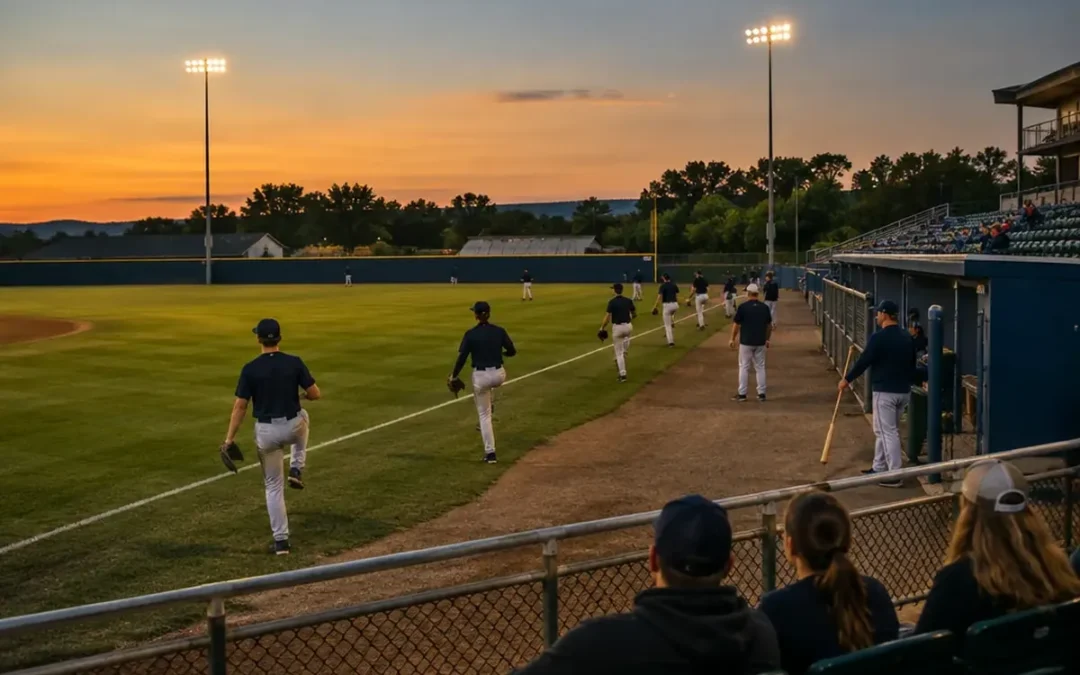
A farm team is a lower-level club that develops players for a parent organization. In baseball, an affiliated farm team is part of a ladder that can take a draft pick or international signing from a rookie complex to Triple-A and, eventually, the majors. It is a system built to move players when performance, health, and big-league roster needs require it.
What a farm team really is in baseball
“Farm system” is the common name for an MLB club’s network of affiliated Minor League teams. The organization “grows” talent by developing young players for the big leagues. The term itself is slang for “farming out” players to subsidiary clubs, first recorded in 1896, and does not come from agriculture.
Before affiliated systems existed, minor-league clubs were independent and major-league teams had to bid against one another to buy players. Branch Rickey, working for the St. Louis Cardinals, built the first modern system in the 1920s and 1930s. A 1921 agreement allowed major-league clubs to own minor-league teams, and the Cardinals were too poor to outbid richer clubs for talent. By 1940, the Cardinals owned 32 clubs and held working agreements with eight more, controlling more than 800 players.
The payoff came fast. The Cardinals had not won a pennant since joining the National League in 1892. They won their first World Series in 1926, then captured nine National League pennants and six World Series titles over 21 seasons.
How the MLB farm ladder gets players ready
Every MLB organization has one full-season club at each of four levels: Single-A, High-A, Double-A, and Triple-A. Across the United States and Canada, that makes 120 full-season affiliated teams. Most organizations also operate rookie-level clubs in Arizona, Florida, or the Dominican Republic, bringing a typical system to seven to nine teams.
| Level | What it asks of a player | Why it matters |
|---|---|---|
| Rookie level | Start professional baseball after a draft or signing. | Complex teams in the ACL, FCL, or DSL introduce the daily pro routine. |
| Single-A | Handle a full-season schedule, travel, and daily competition. | The schedule runs roughly 135–140 games. |
| High-A | Keep advancing against a more demanding full-season level. | It is the next step before the upper minors. |
| Double-A | Prove the tools hold up against tougher competition. | It is widely considered the biggest jump before the majors. |
| Triple-A | Stay ready while refining a major-league case. | It is the highest minor-league level and the main in-season call-up reservoir. |
Players enter through the MLB Draft, international amateur signing, trades, or waiver claims. A player does not have to complete every level: prospects can skip a level, repeat one, or reach the majors directly from Double-A.
Who controls a farm team roster?
Affiliations are governed by Player Development License Agreements, known as PDLs. Under a PDL, the MLB club supplies and pays a full roster and coaching staff. In return, it controls player movement and development. That is why an affiliate’s lineup can change when a player is promoted, optioned, traded, or sent out on a rehab assignment.
A player on the 40-man roster can be recalled to the active MLB roster; if he is not on the 40-man, the club must first create a roster spot. Players on that roster generally receive three minor-league option years. One option is charged when a player spends at least 20 days in the minors during a season, no matter how often he moves up and down. Position players normally must remain down for 10 days after an option; pitchers, 15.
What farm team players are paid
Minor-league pay depends on level and roster status under the players’ first collective bargaining agreement:
- Rookie-level players: $710 per week (up from $290 in 2019).
- Triple-A players: $1,250 per week (up from $502 in 2019).
- Spring training and offseason camp: $660 per week.
- Players on an MLB 40-man roster assigned to the minors: at least $63,600 in-season, more than double the standard Triple-A pay.
Why hockey and basketball do not copy baseball exactly
“Farm team” is used beyond baseball, but the structure changes by sport. Every NHL club has at least one AHL affiliate, the top minor league in hockey. Most also have an ECHL affiliate, creating an NHL–AHL–ECHL ladder. The Toronto Maple Leafs, for example, use the Toronto Marlies in the AHL and the Cincinnati Cyclones in the ECHL. Three NHL clubs have no ECHL affiliate.
The NBA G League has 31 teams, 30 of them NBA affiliates, and every NBA club owns or operates an affiliate. Most G League players are contracted to the league office rather than one NBA club, leaving them available to all 30 teams. Two-way contracts allow teams to carry up to three additional players who split time between the NBA and G League, capped at 50 regular-season games on the NBA active list.
Who are the Toronto Blue Jays farm teams?
Toronto’s seven affiliates stretch from nearby Buffalo to the Dominican Republic. The Buffalo Bisons are the Triple-A club and sit about 59 miles from Toronto. At the other extreme, the Vancouver Canadians are about 2,087 miles away. The New Hampshire Fisher Cats, Toronto’s Double-A affiliate, have been connected to the organization since 2003, its longest continuous affiliation.
- Buffalo Bisons — Triple-A
- New Hampshire Fisher Cats — Double-A
- Vancouver Canadians — High-A
- Dunedin Blue Jays — Single-A
- FCL Blue Jays — Rookie level
- DSL Blue Jays Blue — Rookie level
- DSL Blue Jays Red — Rookie level
Not every affiliate is owned by the parent club. Three Toronto affiliates are independently owned, while the Blue Jays own Dunedin, the FCL club, and both DSL clubs outright.
Which MLB system ranks best depends on the scorecard
Rankings measure different things. MLB Pipeline’s midseason ranking places the Los Angeles Dodgers first, with four prospects among the game’s top 25. ESPN’s total-prospect-value ranking puts the Milwaukee Brewers first at $602.1 million, followed by the Dodgers and Baltimore Orioles, tied at $542.09 million.
The Dodgers have ranked eighth or better in MLB Pipeline’s biannual system rankings for ten straight cycles and in the top five for the last five. The San Francisco Giants climbed from 19th preseason to fourth, marking their first top-five finish since the rankings began. Rankings are a snapshot of prospect value and depth, not a guarantee that every prospect will become a major-league regular.
Four farm-team myths that hide the real story
- Myth: Every player climbs every rung. Reality: Teams can skip a prospect over a level, repeat an assignment, or bring him up from Double-A.
- Myth: An affiliate and an independent club are the same. Reality: Independent teams are not affiliated with MLB, sign their own players, and must be approached as separate clubs.
- Myth: MLB can simply take an independent-league player. Reality: The MLB club must purchase the player’s contract, typically for a buyout of up to $15,000 in the top independent leagues.
- Myth: A high farm-system ranking guarantees a future star. Reality: Rankings assess current prospect quality; they do not promise an outcome.
The Atlantic League, American Association, Frontier League, and Pioneer League are designated MLB Partner Leagues, and top independent leagues can feature talent comparable to Double-A or even Triple-A. Their main goal is winning championships and drawing fans, not supplying one parent club.
Frequently Asked Questions
What is a baseball farm team?
A baseball farm team is a Minor League affiliate in an MLB organization’s development network. It develops players for possible promotion and gives the parent club a place to assign, recall, or rehabilitate players.
How much do farm team baseball players get paid?
Weekly pay ranges from $710 at rookie level to $1,250 at Triple-A. Camp pay is $660 per week, while a 40-man-roster player assigned to the minors earns at least $63,600 in-season.
How many farm teams do NHL teams have?
Each of the 32 NHL teams has at least one AHL affiliate. Teams typically also have an ECHL affiliate, though three clubs have no ECHL affiliate.
Who are the Toronto Blue Jays farm team?
The Blue Jays’ affiliates are the Buffalo Bisons, New Hampshire Fisher Cats, Vancouver Canadians, Dunedin Blue Jays, FCL Blue Jays, and DSL Blue Jays Blue and Red.
Which MLB team has the best farm system?
It depends on the ranking. MLB Pipeline places the Dodgers first, while ESPN’s total-prospect-value ranking places the Brewers first.
How many MLB teams are owned by Jews?
Eight MLB teams have Jewish majority owners, while an additional four teams have Jewish minority owners or presidents.